
NEBAW
Although electrolysis is widely recognized as one of the key methods for extracting hydrogen from water, its use faces significant obstacles related to energy efficiency, material costs, scalability, and energy supply. In addition to these, there is also the environmental impact generated by the demand for water resources, which raises important debates about the viability of electrolysis in areas with already compromised water reserves, limiting its expansion in areas that do not have abundant access to fresh water. Furthermore, the activities involved in obtaining, transporting, and purifying water to achieve the purity required for electrolysis often have adverse ecological consequences, marked by pollution and harmful emissions.
NEBAW proposes to revolutionize this landscape by harnessing atmospheric water, using it in the electrolysis process to create green hydrogen. This approach eliminates dependence on external water sources, facilitating hydrogen production in remote or desert locations with limited access to water. This hydrogen is classified as “green” because it is produced using electricity obtained from a photovoltaic plant with storage, offsetting the intermittency of renewable energies and the costs associated with supply. The verification of this model in the laboratory marks a fundamental milestone towards its future commercialization and expansion, opening up unprecedented opportunities for more distributed green hydrogen production. This method not only points towards a more sustainable and diversified energy network, but also proposes a feasible solution to counteract the difficulties related to water and energy availability in desert or isolated regions globally.
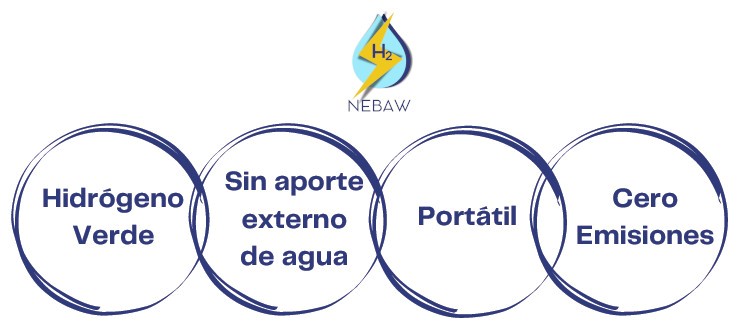
In this scenario, completely eliminating the need for external water would not only represent a monumental advance in environmental protection, but could also revolutionize H2 production, making it possible to generate it autonomously, efficiently, and sustainably in remote locations without the need for nearby water sources. As detailed in the project documentation, the innovative proposal for a “renewed” hydrogen value chain that is self-sufficient in water, capturing and condensing atmospheric moisture, promises to be 100% renewable and free of pollution and emissions, a comprehensive change that respects the environment at every stage of the process. This strategy not only ensures a minimal carbon footprint, but also represents a pioneering solution on the road to a cleaner and more autonomous energy future. To make the whole thing viable, action is being taken in the following areas:
- Development of an atmospheric collection system. Thermodynamic, mechanical, and electrical design of a refrigeration circuit, heat exchangers, and ventilation systems for atmospheric water collection.
- Development of an optimized low-consumption electrolyzer. Incorporation of an absorbent membrane that optimizes impedance, water consumption, and energy requirements. In addition, the development of new catalysts, a gas diffusion layer, and piezoelectric actuators manufactured in-house is proposed.
- Development of a custom compressor. Design of a compressor that adapts to the flow, pressure, and other parameters required by the plant.
- Centralized monitoring and control of the plant. Collection of signals from each piece of equipment, definition of electrical interfaces and communication protocol.
- Construction of a mini photovoltaic power plant. Sizing and design of the system based on the needs of the collection, electrolysis, compression, and communication plant.
- Integration of the solution into a single enclosure. Integration of the different modules into an enclosure to maintain autonomy, portability, and efficiency.
This project has been accepted into Incentive Program 4: Basic-Fundamental Research Challenges of the IDAE Institute for Energy Diversification and Saving within the framework of the Recovery, Transformation, and Resilience Plan. GFM
Funded by the European Union – NextGenerationEU.

Comments
